Get Fat: The 1895 Ad That Sold Weight-Gain Pills to Women
Before anyone was selling weight-loss pills, Loring & Co. was selling the opposite. This 1895 ad tells you everything about how beauty standards get sold.

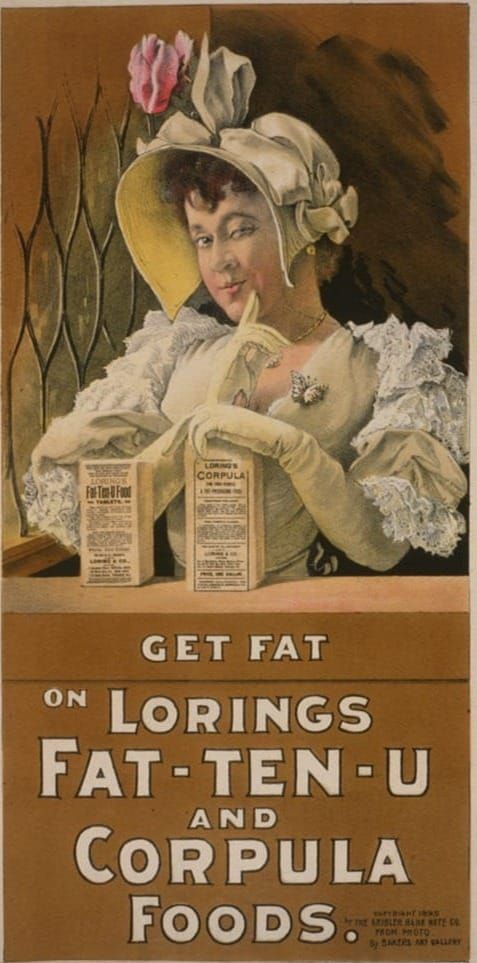
Get fat. The woman in this 1895 advertisement is holding two product boxes with the confidence of someone who already has the answer. She is fashionably dressed, lace-gloved, wearing a bonnet with a pink rose tucked into it. The products she is holding are Loring's Fat-Ten-U Food Tablets and Corpula Foods, sold by Loring & Co., which ran three stores in Boston, Chicago, and New York.
The pitch was simple: thinness was the problem, and Loring had solved it.
The beauty ideal this ad was selling
In the 1890s, the body ideal for middle-class American women was round, not slender. Plumpness signaled health, prosperity, and femininity. Health and beauty books of the era said this plainly. Thinness was the complaint, not excess weight, and the popular literature of the time reflected it. One 1870 beauty manual described a "scrawny bony figure" as "intolerable to gods and men." A popular book of the period was titled, with zero ambiguity, Plumpness: How to Acquire It.
Loring & Co. leaned into it. Their magazine ad argued that thin people couldn't even properly digest fatty foods, so the ordinary methods of gaining weight wouldn't work for them. What they needed was something more scientific. Something like Fat-Ten-U.
What was in it
The honest answer is we don't entirely know, and in 1895 there was no requirement to say. Patent medicines of this era operated in a regulatory vacuum. Manufacturers could claim nearly anything, list whatever they liked (or nothing at all) on the label, and sell across state lines without federal scrutiny. Loring's products were marketed as suitable even for invalids, which was a common pitch in the category.
The word "patent" in patent medicine is itself a small deception. It didn't mean the formula was patented and publicly disclosed. It meant the product had a trade name. The formula was typically a trade secret. What the customer was buying was the claim, not the ingredient list.
The law that ended this era
President Theodore Roosevelt signed the Pure Food and Drug Act on June 30, 1906, making it the first federal law to regulate what went into food and medicine. It required labels to disclose certain substances, banned interstate sale of adulterated or mislabeled products, and gave the government actual enforcement power over an industry that had operated without any meaningful oversight for decades.
It didn't end quackery overnight. The 1906 Act had limits; it regulated labeling more than ingredients, and prosecution was difficult. But it marked the end of the era in which an ad like this one could be published, backed by a product with no disclosed formula and no verifiable claims, as a matter of ordinary commerce.
By the time the Act went into effect, the beauty ideal was shifting. The 1920s brought the flapper silhouette, which moved in exactly the opposite direction from Loring's pitch. The market for weight-gain tablets for fashionable women disappeared.
The ad was exhibited as part of the American Treasures collection at the Library of Congress in 2004 and 2005, which is probably the most legitimizing thing that ever happened to a box of Fat-Ten-U.